Bio
I was
appointed Full Professor in 2004. I obtained my
accreditation to lead research (HDR) in 2002 and a PhD
in Computer Science in 1998.
I completed my "Classes Préparatoires" (Competitive entrance to French
Engineering Schools) in 1988-90, after which
I got my "Ingénieur Agro" degree (MSc in Agronomical Engineering
Sciences, majoring in industrial microbiology and biostatistics)
and a MSc in Computer Science (both magna cum laude) in 1993.
Over the past ten years I have spent approximately 10% of my time as
an invited researcher of other labs, including Sony Computer Science
Laboratories, Inc. (Tokyo, five times), Helsinki U., Ottawa U.,
LIX-Ecole Polytechnique (Palaiseau),
LaHC-U. Saint-Etienne, I3S-U. Nice.
I received in 2013 the "Grand
prix ANR du numérique" --- Press
release (ANR Digital Technology Award; ANR
= French NSF).
Research Projects
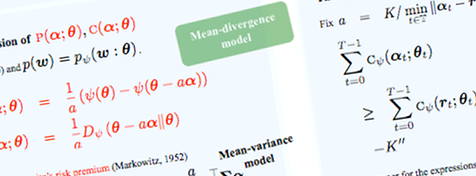
Portfolio allocation theory has been heavily influenced by the mean-variance approach of Harry Markowitz. With colleagues from finance, maths and economics, we have alleviated the Gaussian assumption of the model, derived the exact expression of the risk premium --- which turns out to be a Bregman divergence --- and certainty equivalent in this generalized model, and finally devised in this broader exact model an on-line learning algorithm with guaranteed lowerbounds on its cumulated certainty equivalents.
| ICML 2011 |
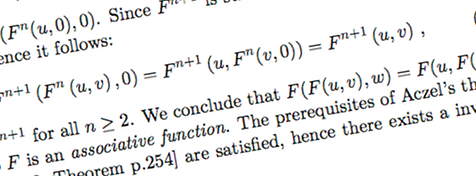
Inequality indices evaluate the divergence between the income distribution and the hypothetical situation where all individuals receive the mean income, and are unambiguously reduced by a Pigou-Dalton progressive transfer. With a colleague from economics, we have characterized the unique class of divergence measures between income distributions that is consistent with popular views of normative economics. It appears to match Bregman divergences (to appear, the Journal of Economic Theory).
| JET 2011 |

With colleagues of maths and computer science, we have studied topological spaces associated with distortion functions that are not metrics: Bregman divergence --- thus that do not meet neither symmetry nor the triangular inequality in the general case ---. Such non-metric spaces are fundamental in statistics, information geometry, classification, etc. . We have considered a large number of problems and algorithms previously known for metric spaces, that we have lifted to these spaces.
| DCG 2010 | TIT 2009 | ECML 2008 | SODA 2007 |
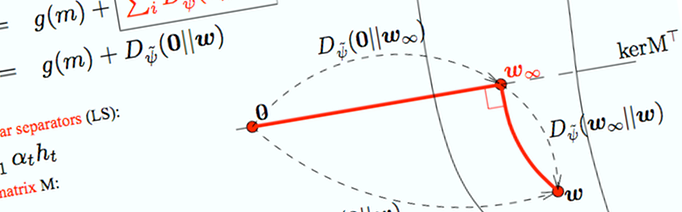
A very active supervised learning trend has been flourishing over the last decade: it studies functions known as surrogates --- upperbounds of the empirical risk, generally with particular convexity properties ---, whose minimization remarkably impacts on empirical / true risks minimization. Surrogates play fundamental roles in some of the most successful supervised learning algorithms, including AdaBoost, additive logistic regression, decision tree induction, Support Vector Machines. Our contributions include new boosting algorithms, unification of popular boosting algorithms, formal convergence bounds.
| IJCV 2012 | TPAMI 2009 | NIPS 2008 | IJCAI 2007 | AIJ 2007 | ICML 2004 |
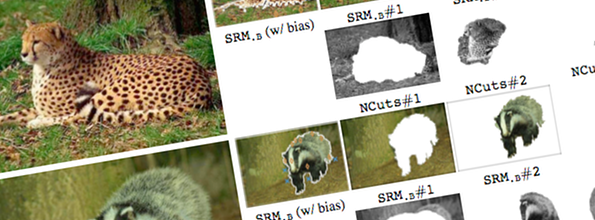
The field of image segmentation is a very active field which seeks to make a partition of an image into regions a user would consider as perceptually distinct. We have created a particular blend of statistics and algorithmics whose error is formally limited from both the qualitative and quantitative standpoints. The algorithm --- which is approximately time and space linear --- can be implemented in straightforward ways, and can be extended to numerous situations where e.g. a user bias is available, images are highly corrupted or occluded, etc. . This algorithm, known as SRM for "Statistical Region Merging", is being used in quite a large number of applications and fields.
| Sources | PRJ 2005 | MM 2005 | TPAMI 2004 | CVPR 2004 | CVPR 2003 | CVPR 2001 |
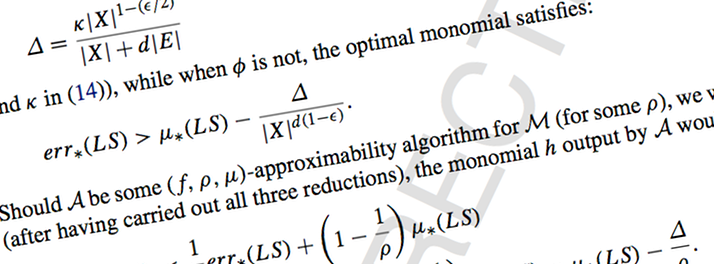
The most popular models of learning, like the PAC model of Valiant, assume time complexity constraint over the algorithms. The lack of known algorithms for particular classifier has naturally questioned whether such algorithms really do exist. Using original reductions known as self-improving --- because they are made from a problem onto itself while blowing-up its hardness --- we have proven numerous inapproximability results for various classifiers, some even translating into negative weak learning results. We kept during a decade or so the largest inapproximability ratio for learning DNF (our ISAAC paper), a popular problem in the late XXth century.
| TCS 2007 | TCS 2003 | ALT 2000 | ALT 1999 | ISAAC 1998 | ILP 1998 | ICML 1996 |