


We are interested in the study of the approximate null-controllability of a
parabolic variational inequality with an obstacle denoted  :
:
 is a bounded open
whose boundary
is a bounded open
whose boundary
 has
has  regularity,
  is a
nonempty open subset of
is a
nonempty open subset of  ,
,
![$Q=]0,T[\times\Omega ,$](img8.png)
![$Q_\omega =]0,T[\times\omega ,$](img9.png)
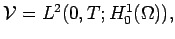
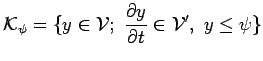 is a closed nonempty convex and
  is a continuous bilinear application on
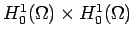 defined by
 with
with
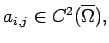
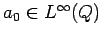 satisfying elliptic conditons.
After introducing a penalized term associated to the obstacle (cf [3]), we show that
(1) can be formulated like a weak limit of a sequence of heat
semi-linear problems. The approximate controllability theory is applied
to this sequence, and by passing to the limit we prove that (1) satisfies approximate
null-controllability condition in the sense that there exists an admissible control
satisfying elliptic conditons.
After introducing a penalized term associated to the obstacle (cf [3]), we show that
(1) can be formulated like a weak limit of a sequence of heat
semi-linear problems. The approximate controllability theory is applied
to this sequence, and by passing to the limit we prove that (1) satisfies approximate
null-controllability condition in the sense that there exists an admissible control
 such that the corresponding solution
 of (1) satisfies
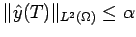 . To obtain our main theorem, we have combined some
results on approximate controllability obtained by various authors (for instance [4], [1], [5]) for Laplace
operators with results based on Carleman inequalities and obtained by Imanuvilov [2]for a class of problems
involving second order differential operators with coefficients
depending on spatial variables.
. To obtain our main theorem, we have combined some
results on approximate controllability obtained by various authors (for instance [4], [1], [5]) for Laplace
operators with results based on Carleman inequalities and obtained by Imanuvilov [2]for a class of problems
involving second order differential operators with coefficients
depending on spatial variables.
